
Just send us your questions or concerns by starting a new case &
we will give you the help you need. Start Here...
NGO Registration
Mon, Jul 20 2026
Raju Karn
Section 8 Company Registration in Noida: Process & Fees 2026
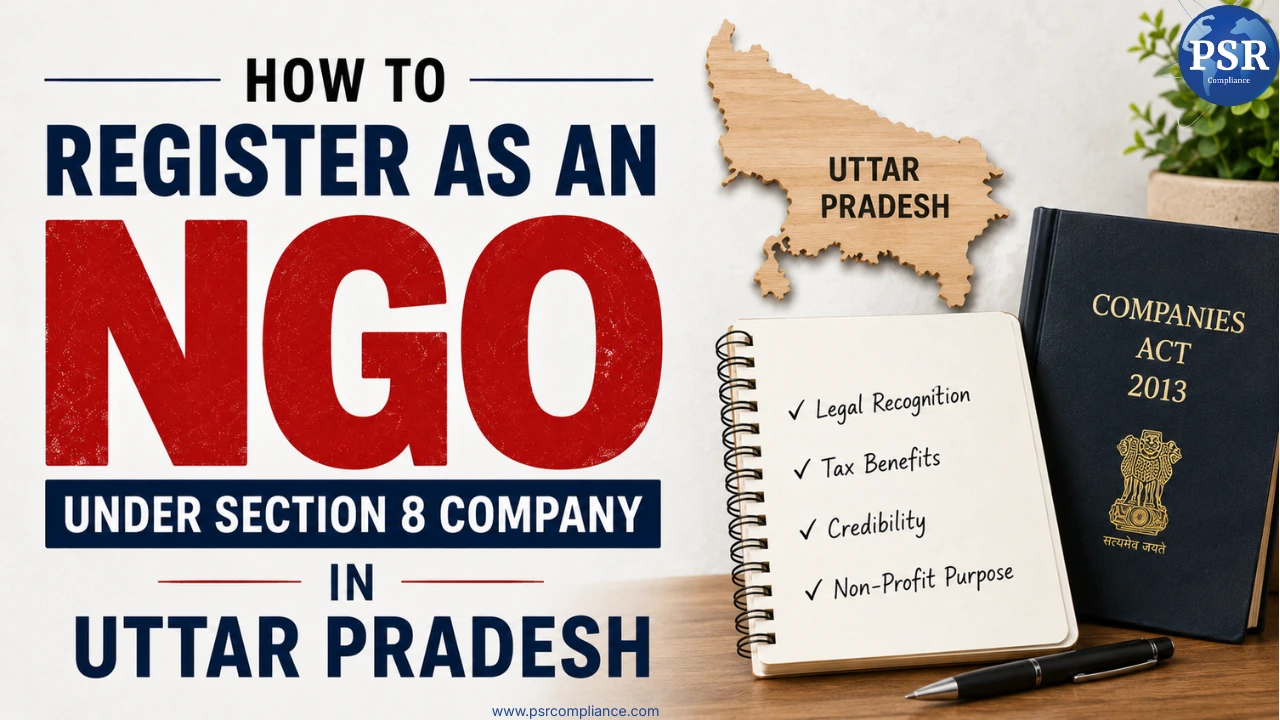
Starting a non-profit organization is one of the best ways to contribute to society while working towards a meaningful cause. If you want to promote education, healthcare, women empowerment, environmental protection, social welfare, science, sports, art, or charitable activities, Section 8 Company Registration is one of the most trusted legal structures available in India. Noida has become a major destination for NGOs, charitable institutions, educational organizations, and social enterprises due to its excellent infrastructure, corporate ecosystem, and easy access to Delhi NCR. Registering a Section 8 Company in Noida provides your organization with a separate legal identity, greater credibility, and eligibility to apply for tax exemptions and CSR funding.
Unlike private limited companies, a Section 8 Company does not distribute profits among its members. Instead, all earnings are used to achieve the organization's charitable objectives.
In this complete 2026 guide, you'll learn everything about Section 8 Company Registration in Noida, including eligibility, benefits, required documents, registration process, government fees, tax benefits, and compliance requirements.
What is a Section 8 Company?
A Section 8 Company is a non-profit organization registered under Section 8 of the Companies Act, 2013. It is established to promote charitable and socially beneficial activities rather than earning profits for its members.
The primary objective of a Section 8 Company is to work for public welfare in areas such as:
- Education
- Healthcare
- Social Welfare
- Environmental Protection
- Scientific Research
- Sports Promotion
- Arts and Culture
- Rural Development
- Skill Development
- Women's Empowerment
- Child Welfare
- Animal Welfare
Any income earned by the company must be used only to achieve these objectives and cannot be distributed as dividends among its members.
Because of its transparent governance and strict compliance framework, a Section 8 Company is often preferred over a Trust or Society by NGOs seeking long-term growth and credibility.
2026 Updates on Section 8 Company Registration
The Ministry of Corporate Affairs (MCA) has continued simplifying the company incorporation process through its integrated online filing system.
Some important updates in 2026 include:
- Company incorporation is processed through the SPICe+ (Simplified Proforma for Incorporating Company Electronically Plus) portal.
- Digital filing has significantly reduced paperwork and processing time.
- PAN, TAN, EPFO, ESIC, GST (where applicable), and bank account-related services are integrated with incorporation.
- Digital Signature Certificates (DSCs) remain mandatory for all proposed directors.
- Companies must continue complying with annual ROC filing and Income Tax regulations after incorporation.
Applicants should ensure all documents are accurate before filing to avoid delays in approval.
Why Register a Section 8 Company in Noida?
Noida has emerged as one of India's fastest-growing business and social development hubs. Several NGOs, charitable organizations, educational institutions, and CSR-funded projects operate successfully from Noida because of its strategic location and business-friendly environment.
Registering your Section 8 Company in Noida offers several advantages:
- Easy access to government departments and regulatory authorities.
- Strong corporate presence increases CSR funding opportunities.
- Better networking with educational institutions and social organizations.
- Excellent infrastructure and professional ecosystem.
- Proximity to Delhi NCR for national-level operations.
Whether your organization plans to operate locally or across India, Noida provides an excellent foundation for sustainable growth.
Benefits of Section 8 Company Registration
Registering a Section 8 Company provides numerous legal, financial, and operational advantages.
Separate Legal Identity
A Section 8 Company has its own legal identity, which is separate from its directors and members. It can own property, enter contracts, and initiate legal proceedings in its own name.
Limited Liability Protection
The liability of members is limited to the amount they agree to contribute, protecting their personal assets.
Higher Credibility
Government authorities, donors, CSR contributors, and funding agencies generally consider Section 8 Companies more credible due to the strict compliance framework under the Companies Act.
Tax Benefits
After obtaining the necessary registrations, such as 12A and 80G, Section 8 Companies may become eligible for income tax exemptions and provide tax benefits to donors.
Eligibility for CSR Funding
Many companies prefer contributing their Corporate Social Responsibility (CSR) funds to registered Section 8 Companies because of their transparent governance and compliance structure.
No Minimum Capital Requirement
There is no mandatory minimum paid-up capital requirement for incorporating a Section 8 Company, making it easier for social entrepreneurs and NGOs to begin operations.
Better Fundraising Opportunities
A registered Section 8 Company is generally more attractive to domestic donors, international organizations, grant providers, and institutional funding agencies.
Perpetual Succession
The company continues to exist irrespective of changes in directors or members, ensuring long-term continuity of operations.
Eligibility Criteria for Section 8 Company Registration
Before applying for registration, applicants must satisfy the eligibility requirements prescribed under the Companies Act, 2013.
Charitable Objective
The primary objective of the organization should be to promote charitable, social, educational, environmental, scientific, cultural, or similar public welfare activities.
Minimum Directors
- Private Section 8 Company: Minimum 2 Directors
- Public Section 8 Company: Minimum 3 Directors
At least one director must be an Indian resident.
Minimum Members
- Private Section 8 Company – Minimum 2 Members
- Public Section 8 Company – Minimum 7 Members
No Profit Distribution
The company cannot distribute profits among its members. Any income generated must be reinvested to achieve the company's charitable objectives.
Compliance with MCA Requirements
Applicants must comply with all Ministry of Corporate Affairs (MCA) incorporation requirements, including obtaining Digital Signature Certificates (DSCs), Director Identification Numbers (DINs), and filing the required incorporation forms.
Suitable Name Approval
The proposed company name should reflect its charitable purpose and must be approved by the Ministry of Corporate Affairs before incorporation.
Documents Required for Section 8 Company Registration
Before starting the incorporation process, applicants should prepare all the required documents. Having complete and accurate documentation helps avoid delays and improves the chances of faster approval by the Ministry of Corporate Affairs (MCA).
The commonly required documents include:
- PAN Card of all proposed directors and subscribers
- Aadhaar Card, Passport, Voter ID, or Driving Licence as identity proof
- Address proof of directors (Bank Statement, Electricity Bill, Telephone Bill, etc., not older than two months)
- Passport-size photographs of directors
- Digital Signature Certificate (DSC) for all proposed directors
- Director Identification Number (DIN) (if not already allotted)
- Registered office address proof
- Latest utility bill of the registered office
- Rent Agreement or No Objection Certificate (NOC) from the property owner (if the premises are rented)
- Memorandum of Association (MoA)
- Articles of Association (AoA)
- Declaration regarding charitable objectives
- Estimated income and expenditure statement (if required)
- Other documents requested by the MCA during verification
Step-by-Step Section 8 Company Registration Process
The registration process has become much simpler with the MCA's integrated online incorporation system. Below is the updated process followed in 2026.
Step 1: Obtain Digital Signature Certificate (DSC)
The first step is obtaining a Digital Signature Certificate (DSC) for all proposed directors.
Since the incorporation process is completely online, DSCs are mandatory for signing electronic forms submitted to the Ministry of Corporate Affairs.
Step 2: Apply for Director Identification Number (DIN)
Every director must have a valid Director Identification Number (DIN).
If a director does not already have one, it can be allotted during the company incorporation process through the SPICe+ application.
Step 3: Reserve the Company Name
The next step is reserving a unique company name through SPICe+ Part A.
The proposed name should:
- Be unique
- Reflect the charitable objectives of the organization
- Not resemble any existing company or trademark
- Comply with MCA naming guidelines
Choosing a meaningful name increases your organization's credibility.
Step 4: Prepare MOA and AOA
The Memorandum of Association (MoA) and Articles of Association (AoA) define the company's objectives, internal management structure, and operational rules.
These documents must clearly specify that the company is established for charitable purposes and that profits will not be distributed among members.
Step 5: File the SPICe+ Incorporation Application
After preparing all documents, applicants must submit the incorporation application through SPICe+ Part B.
The application generally includes:
- Director Details
- Registered Office Address
- Capital Structure
- Subscriber Information
- MoA & AoA
- Required Declarations
- Supporting Documents
The integrated SPICe+ application also facilitates allotment of:
- PAN
- TAN
- EPFO Registration
- ESIC Registration
- GST Registration (where applicable)
Step 6: Verification by MCA
After submission, the Ministry of Corporate Affairs verifies the application and supporting documents.
If additional clarification or documents are required, MCA may issue a resubmission request.
Applicants should respond promptly to avoid unnecessary delays.
Step 7: Certificate of Incorporation
Once the application is approved, MCA issues the Certificate of Incorporation, officially registering the organization as a Section 8 Company.
The company can then legally commence its charitable activities.
Government Fees and Professional Charges
The cost of Section 8 Company Registration depends on several factors, including:
- Number of Directors
- Professional Consultancy Charges
- Digital Signature Certificate Fees
- Government Filing Fees (where applicable)
- Stamp Duty (state-specific)
- Documentation Requirements
Professional fees may vary depending on the complexity of the registration and additional compliance services required. It is advisable to obtain a detailed quotation before starting the incorporation process.
Tax Benefits Available for Section 8 Companies
One of the biggest advantages of registering a Section 8 Company is access to various tax benefits available under Indian law.
12A Registration
After obtaining 12A registration, the income of the organization may become eligible for exemption from Income Tax, subject to compliance with applicable laws.
80G Registration
Organizations registered under Section 80G can enable eligible donors to claim tax deductions on their donations, making fundraising easier.
CSR Funding Opportunities
Many companies prefer contributing their Corporate Social Responsibility (CSR) funds to eligible Section 8 Companies because of their transparent governance and legal recognition.
Foreign Funding (FCRA)
After meeting the prescribed eligibility criteria, a Section 8 Company can apply for FCRA Registration to receive donations from foreign sources legally.
Annual Compliance for Section 8 Companies
Incorporation is only the beginning. Every Section 8 Company must comply with annual legal requirements to maintain its active status and avoid penalties.
Some important annual compliances include:
- Filing Annual Financial Statements with the ROC
- Filing Annual Returns
- Maintaining Proper Books of Accounts
- Conducting Board Meetings as required
- Statutory Audit of Financial Statements
- Filing Income Tax Returns
- Maintaining Minutes and Statutory Registers
- Complying with applicable CSR and FCRA provisions (where relevant)
Regular compliance helps maintain the organization's credibility and legal standing.
Common Mistakes to Avoid During Registration
Many applications are delayed or rejected due to simple mistakes. Avoid the following:
- Choosing a name similar to an existing company
- Submitting incomplete or incorrect documents
- Drafting MoA and AoA without proper charitable objectives
- Providing inaccurate registered office details
- Filing incorrect information in SPICe+ forms
- Ignoring MCA resubmission notices
- Delaying post-incorporation compliances
Seeking professional assistance can help avoid these issues and ensure a smoother registration process.
Conclusion
A Section 8 Company is one of the most reliable and legally recognized structures for individuals and organizations working towards charitable, educational, environmental, religious, cultural, or social welfare objectives. Compared to Trusts and Societies, it offers greater transparency, better governance, enhanced credibility, and stronger opportunities for fundraising and CSR support.
If you are planning to establish an NGO or non-profit organization in Noida, registering a Section 8 Company can provide long-term legal and financial benefits. By following the correct incorporation process, preparing accurate documentation, and complying with MCA regulations, you can build a trusted organization dedicated to serving society.
Whether your mission is to improve education, healthcare, environmental sustainability, or community development, choosing the right legal structure is the first step toward making a lasting impact.
Get Expert Help with Section 8 Company Registration
Starting a non-profit organization? PSR Compliance provides complete assistance with Section 8 Company Registration, NGO Registration, DSC, DIN, SPICe+ incorporation, 12A & 80G Registration, CSR compliance, and FCRA guidance across Noida and India.
👉 Build your NGO on a strong legal foundation with expert support and hassle-free compliance.
📞 Call: +91 8796104190
📧 Email: support@psrcompliance.com
🌐 Website: https://www.psrcompliance.com
Frequently Asked Questions (FAQs)
What is a Section 8 Company?
A Section 8 Company is a non-profit organization registered under the Companies Act, 2013 to promote charitable, educational, environmental, scientific, religious, or social welfare activities.
Who can register a Section 8 Company in Noida?
Any individual, group of individuals, or legal entity with charitable objectives can register a Section 8 Company after fulfilling the eligibility requirements prescribed by the Ministry of Corporate Affairs.
How many directors are required for a Section 8 Company?
A private Section 8 Company requires a minimum of 2 directors, while a public Section 8 Company requires at least 3 directors.
How long does Section 8 Company Registration take?
The registration process generally takes 10 to 20 working days, depending on document verification and MCA approval timelines.
Is there any minimum capital requirement?
No. There is no mandatory minimum paid-up capital requirement for incorporating a Section 8 Company in India.
Can a Section 8 Company earn profits?
Yes. A Section 8 Company can generate income through its activities, but the profits must be reinvested to achieve its charitable objectives and cannot be distributed among members.
Can a Section 8 Company receive CSR funding?
Yes. Many companies contribute CSR funds to eligible Section 8 Companies that work on approved social development projects.
Can a Section 8 Company apply for 12A and 80G Registration?
Yes. After incorporation, a Section 8 Company can apply for 12A and 80G Registration to avail tax exemptions and provide tax benefits to donors, subject to approval by the Income Tax Department.
What is the difference between a Trust, Society, and Section 8 Company?
A Section 8 Company is governed by the Companies Act, 2013 and generally offers stronger governance, higher transparency, and greater credibility than a Trust or Society, making it a preferred choice for many NGOs and CSR-funded organizations.
Can a foreign citizen become a director of a Section 8 Company?
Yes. A foreign national can become a director, provided the company complies with the applicable provisions of the Companies Act, FEMA regulations, and other relevant laws.

